Showing posts with label myth. Show all posts

Friday, 23 March 2018

Pigs and Greeks


For the third day running the rain is lashing against the windows, powerful gales are shaking the shutters, assaulting a rare passer-by or whoever heroically waits at the bus stop. Just below the house the furrows on the vegetable field are saturated with rainwater, brushwood and green onion stalks lying low, looking beaten. Shrouded in thick mist, Mount Hiei smoulders like a massive pyre. Up the famous mountain, somewhere deep in the forest, right now there are wild boars braving the cold.

I imagine them being constantly on the move, alone, trudging the mud from tree to tree, sniffing, looking to shelter from the relentless squall. Recently there has been a resurgence of wild boar in and around the old capital. There have been numerous sightings, and on occasion an animal has been caught on camera, as was the case a few days ago when a well-rounded specimen roamed the grounds of Kyoto University campus.

Who can blame them? A hog is a hog. A hog longs for rummaging but unless one is a hog one does not know why. If I were a boar I’d likely do the same: I’d wallow, I’d forage, I’d drag my snout through dirt, I’d trespass, I’d raid, I’d invade.

In Greek Myth Adonis, Aphrodite’s lover, is killed by a boar. Ovid’s Metamorphoses narrates the legend in ‘Venus and Adonis (and Atalanta)’. In it Aphrodite ‘pillows her head’ on Adonis’ chest as she recounts the story of Atalanta and Hippomenes, two ‘godless lovers’ who make passionate love in a cave shrine ‘older than a human race’, where the wooden images of the ancient gods ‘averted their carved faces in horror’. For their act of sacrilege Atalanta and Hippomenes are transmuted into a pair of lions, ‘with a thorny scrub of a nuptial chamber’.

Aphrodite finishes her tale with a somewhat cryptic message for Adonis to ponder:

            Oh dear love,
            These and others like them, that disdain
            To give your hounds a run but come out looking for the hunter,
            For my sake, O dear boy, let them lie.
            Do not ruin our love with your recklessness.
                                                Ted Hughes, Tales from Ovid, p.141

Alas, soon enough the Fates interfere with the most tragic outcome:

            [Adonis’] hounds woke a wild boar in a wallow.
            When this thug burst out his boar-spear’s point
            Glanced off the bone into the hump of muscle.

            The boar deftly hooked the futile weapon
            Out of the wound and turned on the hunter,
            Overtook the boy’s panic scramble,

            Bedded its dagger tusks in under his crotch
            Then ploughed him with all its strength as if unearthing
            A tough tree’s roots, till it hurled him aside, mangled.
                                                Ted Hughes, Tales from Ovid, p.141-2


In Homer’s Odyssey, the eponymous hero was injured in the thigh as a boy during a boar hunt. The boar emerges suddenly, close by Odysseus

But first [before he could strike] the boar struck him
above the knee, and gashed much of his flesh with his tusk.
                                                Odyssey, 19; 449-450

The scar on his leg proves to be a blessing in disguise when, many years later, it leads Eurycleia to recognize Odysseus on his return to Ithaca. What also strikes me is Homer’s description of the boar before he is disturbed by the footsteps of humans and dogs: the boar lies hidden in his lair, and is completely invisible:

There a great boar lay in its closely-knit lair.
The power of wet-blowing winds could not blow through it,
nor the shining sun strike it with its rays,
nor yet did the rain penetrate it, so solid it was,
and there was a great pile of fallen leaves on it.
                                    Odyssey, 19; 439-443

My image of a boar ‘constantly on the move’ in harsh weather is then most likely incorrect, as the beast seems to be adept at securing itself inside shelters impenetrable to the elements. Well, my lesson for today: check the facts if your imagination soars a bit high.


Sunday, 11 February 2018

Midorogaike Jizo

It is odd to imagine that once upon a time this stately piece lay buried in a peat bog on the outskirts of Kyoto city. The handsome fella is in fact a bodhisattva Jizo statue, and the bog none other than our Midoroga pond. This Jizo is believed to be one of six similar statues carved from a single tree by one Ono-no-Takamura, a scholar who lived, died, then lived again in the early Heian period. The legend tells how the man passed, spent time in the underworld, then rose from the dead after some serious worshipping the Jizo. Once back on earth Takamura set about carving the six statues in the heat of religious verve.

The finished products were individually distributed to guard each one of the six ancient routes linking Kyoto with various towns and municipalities, such as Fushimi, Toba, Nagoya etc. Kurama-kaido connected Rakuchu (inner Kyoto city) to Shiga and beyond. It had the statue – affectionately known by locals as Kuramaguchi, or Midorogaike, or Aneko Jizo – posted at the road’s entrance, serving as a safe journey guardian.

Kurama-kaido used to pass by Midoroga pond. Tradition has it that nearby lay ‘a demon gateway’. The demons were supposed to reside in Kurama and Kifune, a few kilometres north of the pond. In order to keep the wretches at bay, the custom of bean-throwing (mamemaki, 豆まき) sat about at a nearby Yoshida shrine and has been continued to this day as part of the Setsubun (節分) celebrations at the start of spring (Feb 3rd).

It remains unclear though how this particular statue ended up in the bog, or the way it was found and retrieved from its muddy cradle. Currently the statue, all spruced up, sits enshrined at Jozenji near the present day Kuramaguchi subway station – once a boundary separating the inner city (rakuchu) from the suburbs (rakugai), or ‘the world beyond’.

Jozenji is one of those local ‘B-temples’, exuding a certain dose of neglect and lack of refinement (an odd carton box in the worship hall, a motorbike casually stationed by the main entrance). At the same time this semi-lax atmosphere lends it an air of intimacy that is largely absent from its more famous, touristy cousins. In late August pilgrims flock to the temple for the Kyoto Rokujizo Meguri – a pilgrimage to Six Jizo temples. The ceremony involves the worshippers walking along the route connecting the points of the ancient roads, as well as hanging paper amulets (ofuda) outside their homes for exorcising unquiet spirits. The powers of superstition drag on.


Midorogaike
* A pond about 1,500m in circumference
* Creatures surviving since the Ice Age
* Biological communities designated as natural treasures 
* A pond of many legends
* The name’s origin unknown. One link to the discovery of      "Miroku Bosatsu Bodhisattva statue" inside the pond
* Midorogaike 深泥池: a straight reading of kanji impossible, loosely translated as ‘a bottomless muddy pond’

Thursday, 1 November 2012

All Hallows

Silent Witness on the telly: a man’s torso cut open in search of a dodgy bullet
as I fork my spaghetti pink-dusted with Alaskan pollock roe.
Someone goes, Our formative years are embedded in our teeth…
Now there is a sentence to jot down.

Teeth is what Kronos should have used (if he had any) instead of a sickle,
to cut off his father’s splendid balls. Nevertheless the blood
trickled down like honey upon the Cypriot shore to mix flesh with water
from which foamy Aphrodite arose.

My mate Yorghos took me to the borderline, to the strip of no-man’s-land in Lefkosia.
A rubble of concrete and burnt up houses. We stooped to peep through a hole
in the wall: on the Turkish side lookouts sat upon their posts,
armed to the teeth, smoking cigarettes, alert.

This morning this clown of a college teacher shows up wrapped head to toe
in baggy fatigues on which hundreds of frills fidget like dying anchovies. My class
had a Halloween story gaps to fill with any Halloween-ish adjective, dingbat, smudge.
One wrote: ‘Don’t be such a graveyard.’


                                     Aphrodite's Child: It's Five O'Clock

This video relates to the above poem but doesn't have much to do with Halloween am afraid, except that predominant colour is orange, and Demis Roussos looks to me like a cross between Count Dracula and Marlon Brando. Plus, if you look really carefully you will spot a geezer lurking in the background in a vampire's cloak (about one minute into the video). Very strange that setting, come to think of it. Could have it been shot on All Hallows' Eve?

Friday, 14 September 2012

Now and Then


Quintus Curtius Rufus, a Roman historian (1st c. AD) wrote on Alexander the Great and his troubled, at least initially, founding of the city of Alexandria in Egypt: ‘There is a report, that after the king had completed the Macedonian custom of marking out the circular boundary for the future city-walls with barley-meal, flocks of birds flew down and fed on the barley’. Driving through the Republic of Macedonia this summer I wondered if the road builders of the recently-fledged country followed in the great man’s footsteps. Because the long stretches along the ‘Aleksandar Makedonski’ motorway are completely unmarked: no lines of any kind or colour. Have the birds gobbled up the barley?

Driving along the ‘motorway’, dotted with bumps and holes of all shape and size, can be a pretty scary experience, especially at night, the road being unlit save for your car’s headlights and, if lucky, moonlight. That was on the way to Greece, north-south direction. On the way back some nine days later, south-to-north, we knew better and drove in broad daylight. But the persistence of bumps and holes proved too much and eventually steered us off the main highway and onto the local ‘E-roads’, which proved to be – surprise, surprise – in no better state. Only when we got on the very local, virtually vehicle-less 125a, leading through beautiful landscapes along the Pčinja river, only then did we finally open all four windows and let in the warm summer air, scented by sundry wild flowers.

On the Macedonia-Serbian border crossing we were the only customers. Which must be why it took ages both for the Macedonian and the Serbian boys in blue to let us through after giving our passports some seriously close scrutiny. The Pelince border crossing must be one of the most romantic (if that is a suitable word for a border crossing): right in the gully, surrounded by lush forests and so, so quiet, only birdsong and the humming of river is heard.

A ten-minute drive past the border takes you to the St Prohor Pčinjski Orthodox monastery, it being the real clincher behind our original detour. The monastic complex is beautifully arranged, comprised of the St Prohor Church and the magnificent konak, the imposing residential building, sporting a unique architectural style. The place was abuzz with workers, busy with all sorts of repairs and adjustments – you could see something positive was taking place. A further proof for the care and concern for its surroundings was this wooden notice board (see if you can figure out what all the symbols stand for). Click to enlarge.


St Prohor’s life story is a story of a devout and a dedicated anchorite. According to the apparently extensive and well-preserved hagiography, Prohor was born in the first half of the 11th century, into a wealthy and educated family. One day, elated upon hearing Matthew’s ‘He that loveth father or mother more than me is not worthy of me’, Prohor abandoned what remaining shreds of secularity were still fettering him, and left for the high hills, never to return. The next thirty two years (some sources say much longer) he spent living in a small cave with the mountain beasts, sleeping on the bare rock, feeding on wild fruits and grass, drinking water from the mountain spring, never setting eyes on a living human soul.

Well, almost never. The legend goes that one day a hunter hard on the heels of an injured doe, which has just found a shelter with Prohor, comes across the old man, is immediately startled and starts backing off. Prohor calls out to him and the two begin conversing. The hunter turns out to be a Byzantine military aristocrat Diogenes (which Prohor somehow already knew) and eventually Prohor prophesies Diogenes is to become the future emperor of Byzantium. Prohor also pledges Diogenes that once he becomes a king, he should duly remember the old hermit’s prophesy.
 
Decades later, Romanos IV Diogenes (1068-1071) has a dream in which the old prophet admonishes him with words: ‘Why, great Diogenes, have you forgotten your old garb and me the old hermit? Make an effort and build me at least a small temple where I could pray to God until my final days’. The Emperor, frightened, immediately sets off to the north Macedonian mountains to try and find Prohor. After many days of fruitless search, Prohor reappears in Diogenes’ dream and tells him to go to Mount Kozjak and look for a cave above which a white eagle soars, after which Diogenes finally finds the cave and in it the old man’s remains, lying intact and quite unspoiled. On the spot Diogenes builds a small church dedicated to St Luke and further down, at the Pčinja riverbank, another, a more imposing one, where St Prohor’s relics remain to this day.

                             From left to right: Diogenes IV, St Prohor, King Milutin (click to enlarge)
 
Incidentally, Diogenes’ own fate as an emperor turned out to be a sort of royal martyrdom in its own right. This from Wikipedia:

During his reign [Diogenes] was determined to halt the decline of the Byzantine military and stop Turkish incursions into the Byzantine Empire, but in 1071 he was captured and his army routed at the Battle of Manzikert, lead by the Sultan Alp Arslan.
[…] According to a number of Byzantine historians… Arslan at first had difficulty believing the dusty and tattered warrior brought before him was the Roman Emperor. He then stepped down from his seat and placed his foot on Romanos' neck. But after this sign of ritual humiliation, Arslan raised Romanos from the ground, and ordered him to be treated like a king. From then on he treated him with extreme kindness, never saying a cruel word to him in the Emperor's eight-day stay in his camp, and then released him in exchange for a treaty and the promise of a hefty ransom.
[…]In the meantime, the opposition faction scheming against Romanos IV decided to exploit the situation. While still captive [Romanos] was overthrown in a palace coup, and when released he was quickly defeated by the army led by one Andronikos Doukas. Pursued by Andronikos, [Romanos IV] was eventually forced to surrender by the garrison at Adana upon receiving assurances of his personal safety. Before leaving the fortress, he collected all the money he could lay his hands on and sent it to the Sultan as proof of his good faith, along with a message: "As emperor, I promised you a ransom of a million and a half. Dethroned, and about to become dependent upon others, I send you all I possess as proof of my gratitude".
Andronikos stipulated that Diogenes’ life would be spared if he resigned the purple and retired into a monastery. Romanos agreed, and this agreement was ratified at Constantinople. However, John Doukas reneged on the agreement, and sent men to have Romanos cruelly blinded on June 29, 1072, before sending him into exile to Prote in the Sea of Marmara. Without medical assistance, his wound became infected, and he soon endured a painfully lingering death. The final insult was given a few days before his death, when Romanos received a letter from Michael Psellos, congratulating him on the loss of his eyes. He finally died, praying for the forgiveness of his sins, and his wife Eudokia was permitted to honour his remains with a magnificent funeral.
http://en.wikipedia.org/wiki/Romanos_IV_Diogenes

Now, all these machinations have a familiar ring to it. Have the successive governments on the Balkan peninsula in recent history not been their own worst enemies? Have they not been vying for power under any excuse and at any price? Have they not been pursuing their own fat interests instead of ensuring the prosperity of their own citizens? Has this blatant disregard not led many Balkan countries to an economic as well as spiritual cesspit?

As for the spirituality and the church, well, look at Prohor’s shining example and then look at the Orthodox elite in Greece, Serbia, Russia today. In Russia, the Church has acted as Putin’s bodyguard, to paraphrase Hitchens. The highly privileged orders of Greek and Serbian monks are exempt from tax, drive expensive cars, talk on mobiles, and bicker over property and funds. One recent example:

The around 2,600 monks residing at the Vatopaidi monastery in Mount Athos defied the Greek Ministry of Finance last year when it required the so-called autonomous territory pay property taxes on its commercial property.
Mount Athos, a 300 km2 peninsula in Greece, is off limits to women and is exempt from paying VAT. Its mandate prohibits “heterodox or schismatics to live on the Holy Mountain” and states its elected Abbot “must not have been convicted of malversation of monastic property.”
Its chief operator, Abbot Ephraim, is charged with money laundering and embezzlement in a land swap that saw valuable state land traded for less valuable property held by Vatopaidi.
The Hellenic court handed him a six-month suspended sentence in February 2012.
Another monk also took the blame, as well as a former judge from the area in northern Greece where the land swaps took place.
Ephraim, who posted €300,000 bail, was released after four months of detention in Korydallos prison. The former abbot is now residing at the monastery and is not allowed to leave Mount Athos.
The Greek edition of the International Herald Tribune reported that Ephraim called his conditional release "a miracle of the Virgin."
 http://euobserver.com/economic/116962

 Talk about dignity and sainthood.

Saturday, 16 July 2011

Monsters & Fangs


A SAVAGE fish described as more terrifying than a piranha is on Queensland’s doorstep and authorities fear it may soon be here. The vicious giant snakehead, which has been the star of a horror movie trilogy, eats everything it comes across and has even been reported to kill people. The monster from south-east Asia has a mouth crammed with fearsome teeth, can “crawl” on land and survive out of water for up to four days.  
http://jamesboard.wordpress.com/2010/04/07/come-to-australia-you-might-accidentally-get-killed/


This snakefish was caught in England. In an article entitled Killer fish terrifies Britain News.Com (as in Rupert Murdoch) describes that snakefish as “A savage fish that eats everything it comes across, including people. The discovery of the fish is reported to have caused widespread panic among conservationists and anglers. An Environmental Agency source described the snakefish as “the ultimate invasive species”. The source said that if snakefish begin breeding in the area it will be a disaster.  
http://theframeproblem.wordpress.com/2008/02/19/the-snakefish-a-concerning-ecological-threat/272/

               The Eight-Forked Serpent (Yamata no Orochi)

‘[…] its eyes were red as the winter cherry, and pine trees and mosses grew on its back, while firs sprouted on each of its heads. As it crawled, it stretched over eight valleys and eight hills, and its belly was always flecked with blood. In seven years this beast had devoured seven maidens, the daughters of a king, and in the eighth year was about to eat up the youngest, named Princess-Comb-Ricefield. The princess was saved by a storm-god who bore the name of Brave-Swift-Impetuous-Male. This knight built a circular enclosure of wood with eight gates and eight platforms at each gate. On the platforms he set tubs of sake. The Eight-Forked Serpent came and dipped its head into each of the tubs, gulped down the sake and was soon fast asleep. Then the knight lopped all of the heads, a river of blood springing from the necks. In the serpent’s tail a sword was found…’
                                        from The Book of Imaginary Beings by J.L.Borges (pp. 55-6)

                                  Yamata no Orochi by Toyohara Chikanobu (1838–1912)

It took me couple of minutes to realize all 8 heads are in here! Click on the pic and time yourself.

* (caption taken from http://themurdochempireanditsnestofvipers.blogspot.com)

Tuesday, 7 December 2010

Myths Past & Future: EXPO '70

Urashima Taro revisited (see my earlier post MYTHS II): the ancient Japanese myth with a 70's Brazilian touch. 


This commercial was made by Varig airlines to promote flights to the World Exposition EXPO '70, hosted in Osaka in March - September 1970. So, on to EXPO 70.
EXPO 70 hosted 77 countries at its pavilions and had 66 million visitors. Among many interesting exhibits were lunar rocks brought to earth by the Apollo 12 astronauts, the first ever IMAX film, and the two time capsules. The capsules were identical, filled with over 2000 artefacts of modern life as it was in 1970. At present the capsules are buried deep underground adjacent to Osaka castle. The lower capsule is due to be opened 5000 years from now, in 6970 to be precise. The capsule contains a plutonium atomic clock which operates by moving its hand 3mm every 100 years.


a very detailed info on this here: http://panasonic.net/history/timecapsule/

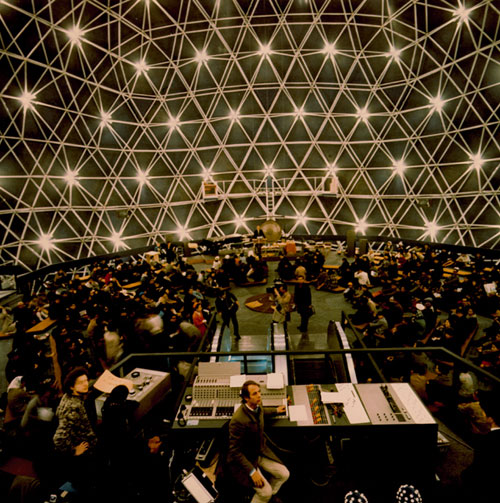
The USA pavilion at Expo 70 contained some of the coolest, if extravagantly ambitious, projects, such as the invisible air columns (people actually walked right through them without noticing it) which actually supported the exhibition hall roof. The EAT (Experiments in Architecture and Technology) had various floats, fog-contraptions and light frame sculptures, all of which moved around and cut through the plaza, creating a multimedia construct, dubbed in those days 'the expanded cinema', a concept which
...could stimulate the mind with its synaes­thesic effects and restore sensation to bodies dulled by routine... 
At the World’s Fair in Osaka in 1970 E.A.T. teamed up with Pepsi-Cola to produce an experi­mental and interactive environment. EAT turned the experience of visiting the pavilion into one of sensory overload. ‘Visual sounds’ were produced with coloured lasers and electronic music by composer Lowell Cross.
Visitors to the pavilion were able to turn their visit into an interactive experience with audio handsets that could pick up audio signals on loops fixed in the pavilion structure or create three-dimensional images of themselves using a pneumatic hemispheric mirror created by Whitman. The dome of the pavilion was cloaked in a perpetual cloud of artificial fog conceived by Frosty Myers as an allusion to Mount Fuji (much to the frustration of nearby food and souvenir vendors who demanded a fog trap).


Artistic optimism paired with corporate swagger? A cold war paranoia subtext or the liberating effects of the visual/aural play? A subliminal 'blast on the senses' or a pointless sensory exercise? Hmm... maybe bit of everything. Perhaps David Crawley is right when he says that the unhappy marriage between the artistic innovation and corporate interest had no message per se, apart from showing us the roots of our current 'multimedia environment lie in the East-West competition which gripped the world more than 50 years ago.' Perhaps Davis Brody, the architect of the US pavilion at EXPO 70, is right when he notes that
the open, relaxed, sheltered environments created by a climate-controlling, light-transmitting dome might encourage the virtues of small lively towns, which have so conspicuously ceased to exist.
(source: http://www.columbia.edu/cu/gsapp/BT/DOMES/OSAKA/o-infin.html)

The West German pavilion at EXPO 70 featured the world's first, and so far the only, spherical concert hall 'Kugelauditorium', based on artistic concepts by Karlheinz Stockhausen. With its 3-dimensional sound, its 50 groups of loudspeakers ('the perfect loudspeaker'), and with Stockhausen's five-and-a-half-hour live programs of his music every day over a period of 183 days, 'many visitors felt the spherical auditorium to be an oasis of calm amidst the general hubbub, and after a while it became one of the main attractions of Expo 1970' (Kurtz, Michael, Stockhausen: A Biography, 1992).

                                                              Inside the Kugelauditorium (www.stockhausen.org)

Take a look at this bizarre performance from another era, of Stockhausen's 'Helikopter-String Quartet' (1995): the tonal audacity on a reconnaissance mission. Experimentalism verging on self-mockery.


Back to Expo '70, which also featured demonstrations of early mobile phones and maglev train technology. Here are some nice commemoration stamps (clickable for bigger images):


You can watch a 9-minute docu-film about the event here:


Funny and rather poignant, those people first in line to rush through the gates, running (literally) toward the vast exhibition grounds. Reminded me of those poor souls last Christmas at Topshop (or was it two years ago?), when everything was so cheap, scrambling for bargains like hungry hyenas (which of course was a far more depressing sight). Back to the EXPO video: just look at those queues with no end in sight. Hours and hours of waiting. But not all is gloom. This footage of EXPO 70, (on about the 4th minute-mark) shows masses in their national hats and costumes, dancing happily together on a vast disco-like-dancefloor (before discos were discovered). I wonder what kind of music they were dancing to. Judging from their bliss-struck faces they would've probably responded to anything rhythmical, or as long as it conformed to that huge banner above their heads: TOWARD BETTER UNDERSTANDING OF EACH OTHER. How bitterly naive that sounds 40 years later in the age of mistrust, scepticism, secrecy, shameless materialism.

Tuesday, 30 November 2010

MYTHS IV

THE CURSE

‘…yesterday for the first time I couldn’t remember a Bosnian word for a birch tree,
I had to look it up: “breza”… Asija, I don't remember the birch trees.’
– Saša Stanišić, How the Soldier Repairs the Gramophone

My father’s father, Branko M.,
a woodcutter, enters the poem,
struck down by a Bosnian birch.
His face hangs on the wall not far
from our family icon St George.
The family allege Branko saved
another mate during the tree-fall
as his axe lay not far from the body
(my old man doesn’t recall
being a pink-skinned baby).

Branko M., my lost relative,
drowned in the turbid Danube.
His motive? His refusal to live.
They found his clothes neatly folded
on the beach pebble stones.
If only his life was as neat
by which my family must’ve meant
he’d hurt himself rather than those
who made his life morose.

I’d better unbecome Branko.
I crawl from under the tall birch
that killed me. I begin my search
for the saved in my previous lives.
A few links later I am riding
Urashima Taro’s tortured tortoise,
its feet the beautiful hands
of princess Otohime, saved in vain.
I’ll open a gift she bid Taro not to,
the cursed cube of tamatebako.

I’d better unbecome Branko.
I search for Wang Zhi, a carpenter,
a solid birch for his axe handle.
Dead of winter. On a felled branch
two men crouch over a board.
I watch the shade-pitted pieces
appear and disappear, outwitted
by the flickering light of a candle.
When their game’s up, which is never,
and I come to, the axe handle
is my decomposed arm.

Unbecoming Branko won’t do
unless I keep a piece of my cursed name.
I am therefore Bran, son of Febal.
In my birch coracle I set sail
south-southeast from the Irish Sea
via the Channel, the Rhine upstream
into the Prussian blue Danube –
which, before I was made a Serb,
flowed ultramarine.

I’ve reached the Island of Women.
I, a self-made citizen of the Serbian
Tír na nÓg. Lying naked, unseen
from the Singidun turret,
ignored by hunger thirst fears.
I unfold my paper cube tears
before the women lament – your
homecoming, Bran, looks imminent.

Come morning, I am forty-one.
At the fate-prescribed time
the curse is bound to charge.
My name will thus be undone
and, as such, axe-inscribed
on my own struck down birch.

November, 2010